
Have a Profit to Reinvest? Crawford County May Soon Offer a Federal Tax Break

Updated: Oct 14
What Opportunity Zones are, what changes in 2027, and why two Crawford County communities are worth watching.
The short version
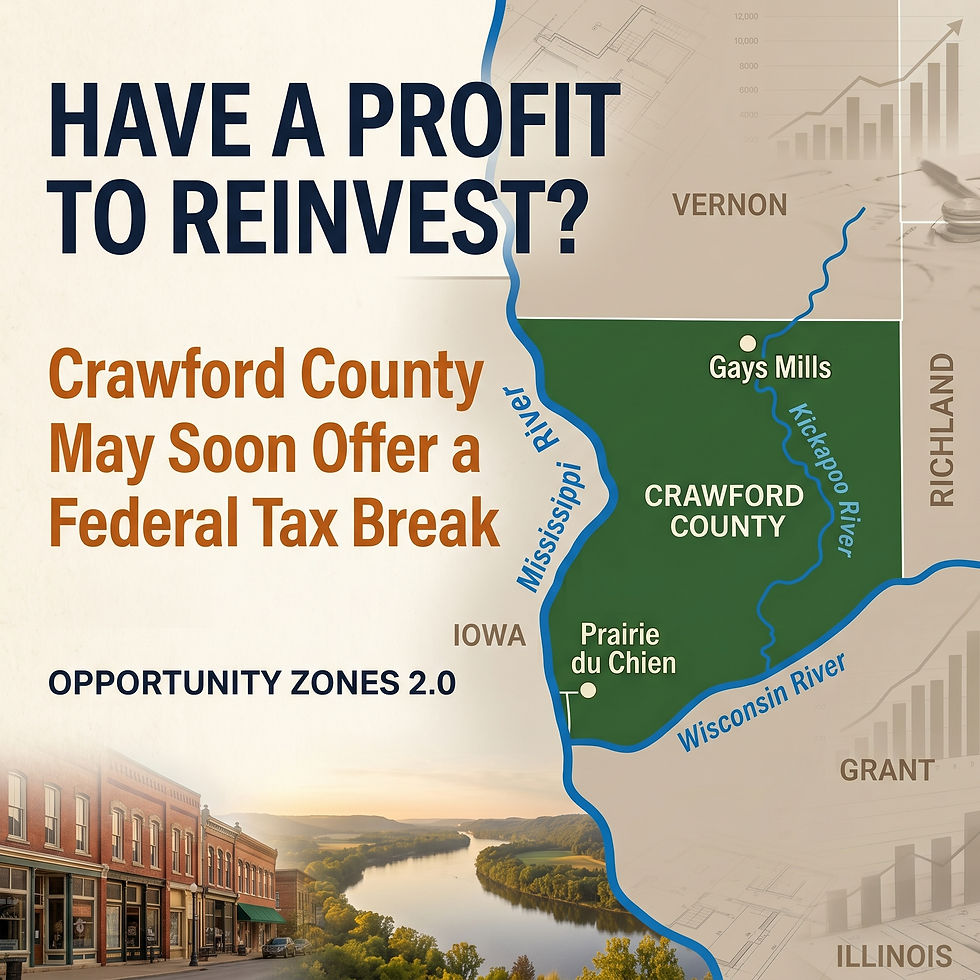
Two areas of Crawford County, Wisconsin, one in Prairie du Chien and one in the Village of Gays Mills, are being considered for the next round of federal Opportunity Zones, known as Opportunity Zone 2.0.
An Opportunity Zone is an area where investors get a federal tax break for putting money into local projects. If these two areas are selected, people who reinvest profits from selling stock, real estate, or other assets here could put off, shrink, and in some cases wipe out part of their federal tax on those profits, starting January 1, 2027.
This is written for anyone with money to invest: individuals who have recently sold something at a profit or plan to, family offices (private firms that manage a wealthy family's investments), business owners, developers, and companies. You do not need to live or work in Crawford County to use this. You only need to invest here.
What an Opportunity Zone is, in plain English
Opportunity Zones are drawn using census tracts, the neighborhood-sized areas the U.S. Census Bureau uses to count people. A tract is usually home to a few thousand residents. Congress created the program in 2017 to draw long-term private investment into lower-income city and rural areas. Each governor picks a limited number of eligible tracts in their state, and the U.S. Treasury signs off on them. In Wisconsin, applications are reviewed by the Wisconsin Economic Development Corporation (WEDC), the state's economic development agency, together with the state's housing finance authority (WEDC).
Here is the basic idea. When you sell something for more than you paid, such as stock, real estate, or a business, that profit is called a capital gain, and you normally owe federal tax on it. If you instead reinvest the profit within 180 days into a special kind of investment fund that puts money into Opportunity Zones, the tax code rewards you for leaving it there for the long haul (IRS).
So what is a Qualified Opportunity Fund? Think of it as the container your gain has to go into. You cannot get these tax benefits by buying a building in an Opportunity Zone on your own. The money must flow through a Qualified Opportunity Fund, or QOF (OpportunityZones.com).
In practice, a QOF is usually an LLC or partnership, though it can also be a corporation, formed to invest in Opportunity Zones. It can buy and improve real estate in a zone or invest in a business that operates there. To keep its status, it must hold at least 90% of its assets in qualifying Opportunity Zone property (Squire Patton Boggs), and it certifies itself with the IRS each year (IRS).
There are two ways in:
Invest in someone else's fund. A company that organizes and manages the fund raises money from many investors and runs the projects. You put money in and let them handle the rest.
Start your own fund. An individual, family, or business forms its own QOF and uses it to buy, build, or improve property in a zone directly. More control, more work.
What changes in 2027, and why rural places come out ahead
In 2025, Congress passed a major tax law, the One Big Beautiful Bill Act, that made Opportunity Zones permanent. Instead of a one-time program, the list of zones now gets redrawn every 10 years. The new zones take effect January 1, 2027, and last through December 31, 2036 (WEDC).
The new law gives rural areas a bigger reward, so two terms are worth knowing first:
Rural zone: an Opportunity Zone outside any city or town of more than 50,000 people, and outside the built-up area around such a city (WEDC). Both Crawford County tracts are small communities far from any city that size.
Rural fund: an Opportunity Fund that keeps at least 90% of its money in rural zones. The larger rural tax break goes to investors in these funds, not to any fund that happens to own one rural project (Adams and Reese).
The key changes for investors:
You can put off the tax for five years. If you reinvest a profit, you do not pay tax on it until five years after you invest. Under the original program, everyone faced the same fixed deadline instead (Wiss).
You pay tax on less of the profit. When the five years are up, you pay tax on only 90% of the original profit. In a rural fund, you pay on only 70% (WEDC).
Your new investment can grow tax-free. If you keep your money in the fund for at least 10 years, you owe no federal capital gains tax on what it earned while you held it. That tax-free treatment covers growth up to the 30-year mark (Adams and Reese).
Older buildings are easier to use in rural zones. For an existing building to count, a fund normally has to spend about as much fixing it up as it paid for the building itself. In rural zones, it only has to spend half that (Adams and Reese).
There will be fewer zones. The rules for which areas qualify are tighter. Wisconsin is expected to have about 77 zones in this round, down from 120 (WEDC).
What it means for someone with capital to invest
Put simply, an Opportunity Zone investment can do three things for you: push your tax bill out five years, shrink that bill, and let the new investment grow tax-free if you stay in for 10 years or more.
Here is a simplified example. Say you sell stock or property you have owned for more than a year, and your profit is $1,000,000. At the highest federal rate, that profit is taxed at 23.8%: a 20% capital gains tax plus a 3.8% tax on investment income. This example covers federal tax only, not state tax.
Option | Federal tax on the original gain | When it is paid |
Pay the tax now | $238,000 | This year |
Invest the gain in a standard Opportunity Fund | $214,200 (on 90% of the gain) | After five years |
Invest the gain in a rural Opportunity Fund | $166,600 (on 70% of the gain) | After five years |
In the rural case, that is $71,400 less in tax on the original gain, paid five years later. On top of that, if you hold the fund investment for at least 10 years, any increase in its value is free of federal capital gains tax. For a patient investor, that last piece is often worth the most.
Who this fits. Anyone who sells something at a profit can use an Opportunity Zone. There is no income or wealth requirement, and the law sets no minimum investment (WEDC). In practice, it tends to work best for larger profits. Many funds run by outside companies require $50,000 or more and are open only to accredited investors, a federal category for people with income over $200,000 a year ($300,000 for couples) or a net worth over $1 million not counting their home (SEC). There are also yearly tax forms and advisor fees, so the numbers usually work best for profits of $50,000 or more. Starting your own fund takes more work and generally makes sense with $250,000 or more to reinvest (OpportunityZones.com). If your profit is smaller, it is still worth asking your tax advisor whether it makes sense for you.
Only the profit counts. If you sold something for $1.5 million that you bought for $500,000, only the $1 million profit can get the tax break. You can put in more than that, but the extra dollars get no tax benefit.
Why the timing matters now
The new list of zones is being decided right now, and some profits from sales made in 2026 can still take advantage of it.
Where Wisconsin stands, as of mid-October 2026:
July 31: WEDC closed its application window for communities hoping to be nominated (WEDC).
October 28: Wisconsin's nominations are due to the U.S. Treasury, under the 30-day extension available to states (OZ 2.0 State Tracker).
By late December: The U.S. Treasury gives final approval to each state's zones (OZ 2.0 State Tracker).
January 1, 2027: The new zones go live for investment.
Designation is not guaranteed. Wisconsin can nominate only about 77 tracts statewide, so many worthy places will be left off (WEDC).
If you sold something at a profit this year. You have 180 days after a sale to reinvest the profit. Under the original program, any profit put into a fund in 2026 becomes taxable on December 31, 2026, so investing this year saves you almost nothing. IRS guidance issued in June 2026 confirms that if your 180 days stretch into 2027, you can wait and invest on or after January 1, 2027, under the better new rules (Cherry Bekaert). For a sale you made yourself, that generally means a sale in the second half of 2026. If the profit came through a business you co-own, such as a partnership, you may have even more time (McDermott Will & Schulte). Your tax advisor can confirm your dates.
For example, if you sell stock or property in mid-October 2026, your 180 days would run until about mid-April 2027. That leaves roughly three months after the new zones take effect on January 1 to choose a fund, or set up your own, and invest. Setting up a fund takes some lead time, so it helps to start that conversation with your advisor before the new year.
Sell in October, invest by April: your 180-day window can reach into the new zones.
No need to wait on us. If you have a profit to reinvest, nothing about this requires you to hold off or rush. The new zones, wherever they end up, will be open to investment for ten years, from 2027 through 2036.
What happens next. Wisconsin’s nominations go to the U.S. Treasury by October 28, and Treasury will confirm the final list of zones by late December. We will share the news here as soon as we know whether Prairie du Chien and Gays Mills made the list. If you would like to hear first, let us know and we’ll put you on our update list.
Why it matters for the community
Opportunity Zones only work when private money shows up, and the first round shows it does. Treasury data through 2024 reports more than $112 billion invested in over 6,000 communities. Rural tracts were just as likely as urban ones to see investment, but the average rural tract received about $7.3 million, compared with $23.3 million in the average urban tract (Economic Innovation Group). That gap is a big part of why Congress tripled the rural benefit for this round.
For small communities, the 10-year timeline is the point. Because the biggest tax savings go to investors who stay at least 10 years, the program rewards building something that lasts rather than buying and quickly selling.
Crawford County. Both areas under consideration are rural communities in Wisconsin's Driftless Area that have already done much of the groundwork with public investment and local planning. What tends to be missing is private investors willing to commit for the long term. The kinds of projects that fit a place like ours include workforce housing, renovation of older downtown buildings, lodging and other businesses tied to river and outdoor tourism, and money to help local businesses grow.
The Prairie du Chien area is already an Opportunity Zone, the only one in Crawford County, from the program's first round in 2018. But first-round zones are not automatically renewed. Under IRS guidance on the switch to the new program, property bought after 2026 in a first-round zone that is not chosen again generally will not qualify for the tax benefits (Winthrop & Weinstine). That makes renewing Prairie du Chien's designation especially important. The Gays Mills area would be a new Opportunity Zone.
Things to keep in mind
It is long-term money. The full benefit takes 10 years. These investments are hard to sell early and often pay little or nothing in the first several years (OpportunityZones.com).
The tax break does not remove investment risk. A weak project is still a weak project. Look closely at who runs the fund, their track record, the fees, and how much of their own money they have put in.
The fund has to qualify. The money must go through a Qualified Opportunity Fund, and the larger rural tax break requires a rural fund.
More reporting is coming. Funds and the businesses they invest in face new federal reporting requirements under OZ 2.0 (Wiss).
Rules are still being finalized. The IRS has issued early guidance and plans to publish more detailed rules, which could change some specifics (Greenberg Traurig).
Check state treatment. This article covers federal tax. See the Wisconsin Department of Revenue for state rules.
Talk with a CPA, tax attorney, or financial advisor before acting.
Learn more
Official and nonpartisan sources:
WEDC: Opportunity Zones 2.0 Overview, Benefits, and Wisconsin Process. Wisconsin's official page, with FAQs and the state timeline.
IRS Notice 2026-40 (PDF). IRS guidance on how the switch from the original program to the new one works.
Congressional Research Service: Opportunity Zones Round Two Selection Process FAQ. How the new designations are chosen.
Economic Innovation Group: Why OZ Designations Matter. A plain-language read of Treasury's data on the first round.
Wisconsin Department of Revenue: Qualified Opportunity Zones FAQ. State tax treatment.
Industry resources (commercial sites, useful for exploring funds and tracking progress):
OpportunityZones.com: The Two Ways to Invest in Opportunity Zones. Active versus passive investing, and questions to ask a fund.
OpportunityZones.com: OZ 2.0 State Tracker. Where each state's nominations stand.
OpportunityZones.com is a for-profit media company supported by sponsors, as it notes in its own disclosure.
If Crawford County is part of your story
Some people reading this grew up here, have family here, or spent summers on the river and never quite left it behind. Maybe you moved away for school or work and built a life somewhere else. If you have done well and have a profit to reinvest anyway, this is a way to put some of it back into the place that shaped you, with a real tax benefit for doing it.

What drew people here is still here: the bluffs and coulees, the spring-fed trout streams, the Mississippi at Prairie du Chien, and the orchards in the hills around Gays Mills every fall. These communities don't need rescuing. They need a few investors willing to back the next house, the next storefront, or the next small business, and to stay in for the long run.
You don't have to move back to make a difference here. If you have money to invest, or will soon, keep Crawford County in mind and reach out. Even a conversation helps. And if you've ever thought about coming back for good, take a look at Come Home to River Country.
Keep Crawford County on your radar
If you or your clients have profits from a sale to reinvest, now or soon, we would like to hear from you. That includes individual investors, family offices, fund managers, developers, and companies, whether you are local or have never been to the Driftless Area.
Driftless Development, Inc. is Crawford County's economic development organization. We can share the latest on designation, connect you with local partners and community leaders, and help you understand what is happening on the ground in Prairie du Chien and Gays Mills.
If this was useful, please pass it along to your tax advisor, your investment group, or anyone you know who is looking for a place where their capital can do real good.
A note on this article
This article is for general information only and is not tax, legal, or investment advice. Driftless Development, Inc. does not sponsor, sell, or recommend any security or fund. Opportunity Zone designations for Crawford County are pending and are not final until certified by the U.S. Treasury. Program rules may change as federal guidance is finalized. Information is current as of October 13, 2026.

Comments